Why in today’s market, judgment matters more than timing or listings
Over the past year, discussions around the Bali property market have become increasingly polarized. Some narratives continue to emphasize long-term lifestyle appeal and international demand, while others focus on rising competition, softer yields, and growing execution risk. This divergence is not unusual—but in 2025, it reflects a structural shift in market conditions rather than sentiment alone.
Before asking whether Bali property is still “worth buying,” a more relevant question should be addressed: does the current market still absorb mistakes in judgment? This article does not aim to provide a buy-or-sell recommendation. Instead, it examines how recent market data changes the risk profile for buyers who are already reviewing specific projects, or who are being pushed toward early-stage commitments.
The data referenced in this analysis is drawn primarily from the REID Bali Property Market Report, Q3 2025. These figures are not used to forecast price movements, but to understand how the underlying structure of the market is evolving—and what that means for decision-making today.
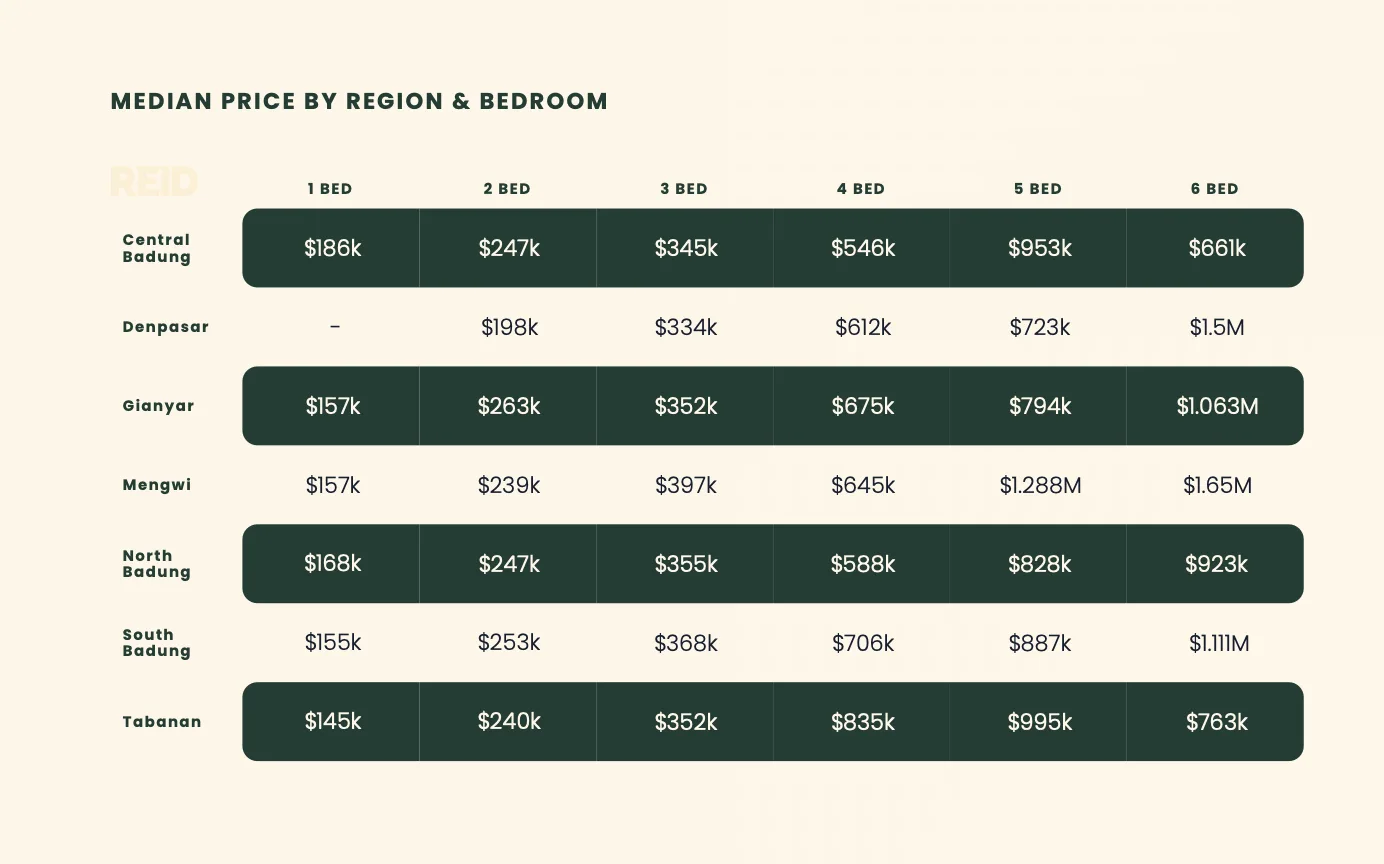
One of the clearest signals comes from pricing behavior. According to REID’s median price data by region and bedroom count, most core areas of Bali have entered a period of price stabilization rather than continued upward momentum.
Source: REID, Bali Property Market Report Q3 2025
This does not indicate a market downturn. However, it does mean that price appreciation can no longer be relied upon to offset early misjudgments. In a flat market, projects with weak pricing logic, flawed positioning, or thin cost buffers have limited room for correction. Initial judgment, rather than market timing, becomes the dominant factor.
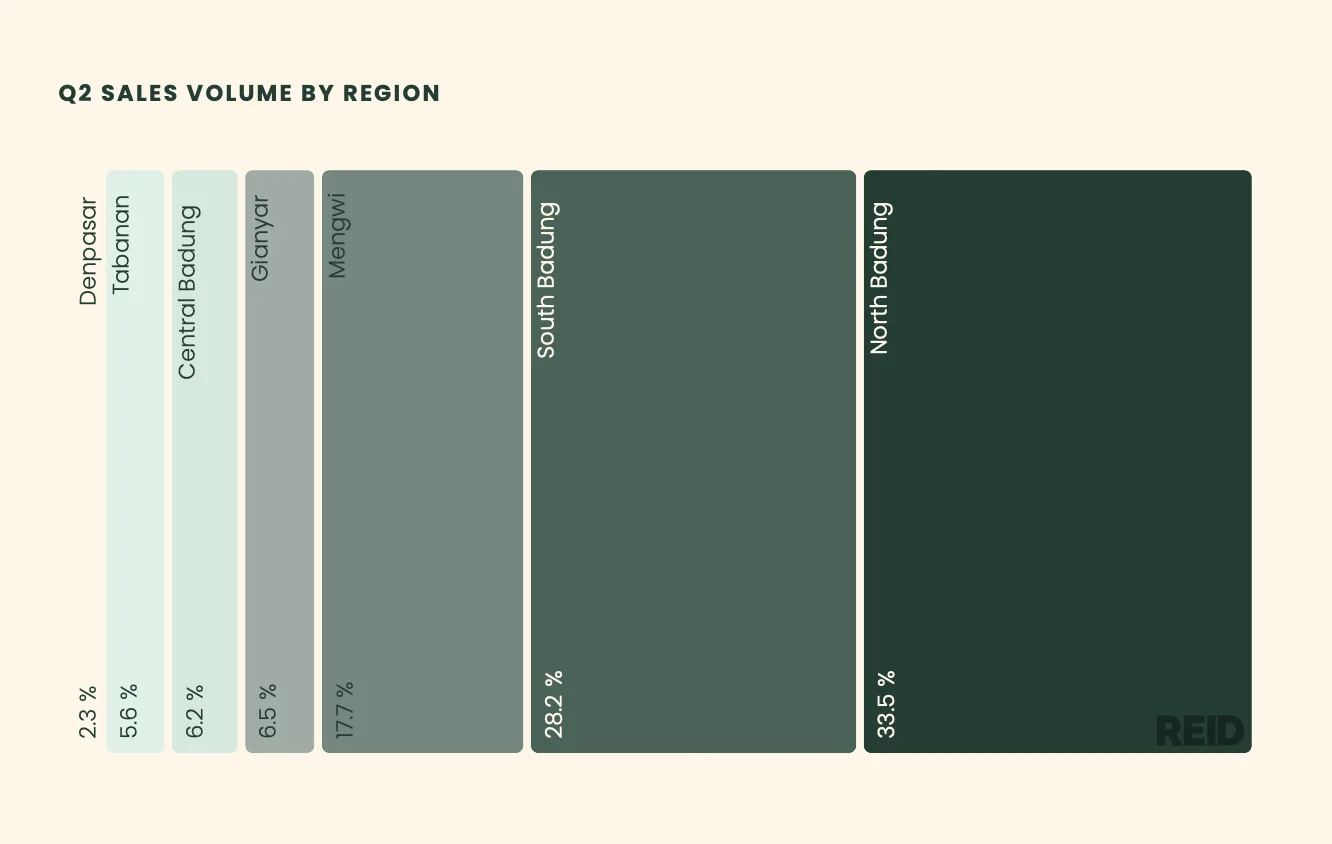
Transaction data reinforces this shift. Sales volumes remain concentrated in key regions such as North and South Badung, which at first glance suggests continued market strength. However, the more meaningful change is happening within these regions.
Source: REID, Bali Property Market Report Q3 2025
On a project-by-project level, performance divergence is becoming increasingly visible. Location alone no longer provides sufficient protection. Execution quality, product differentiation, and developer reliability are now decisive variables. Being in the “right area” is necessary—but no longer sufficient.
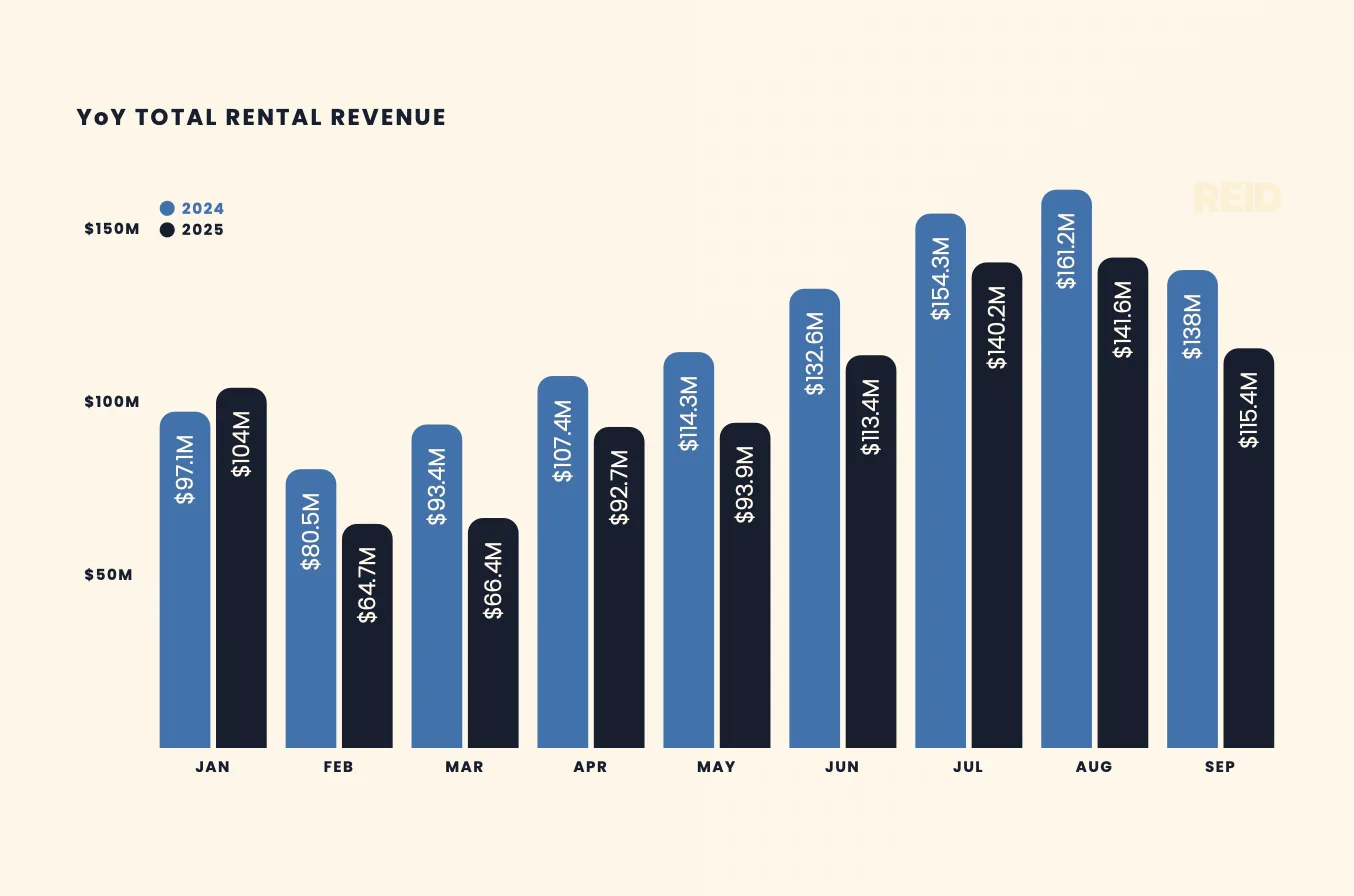
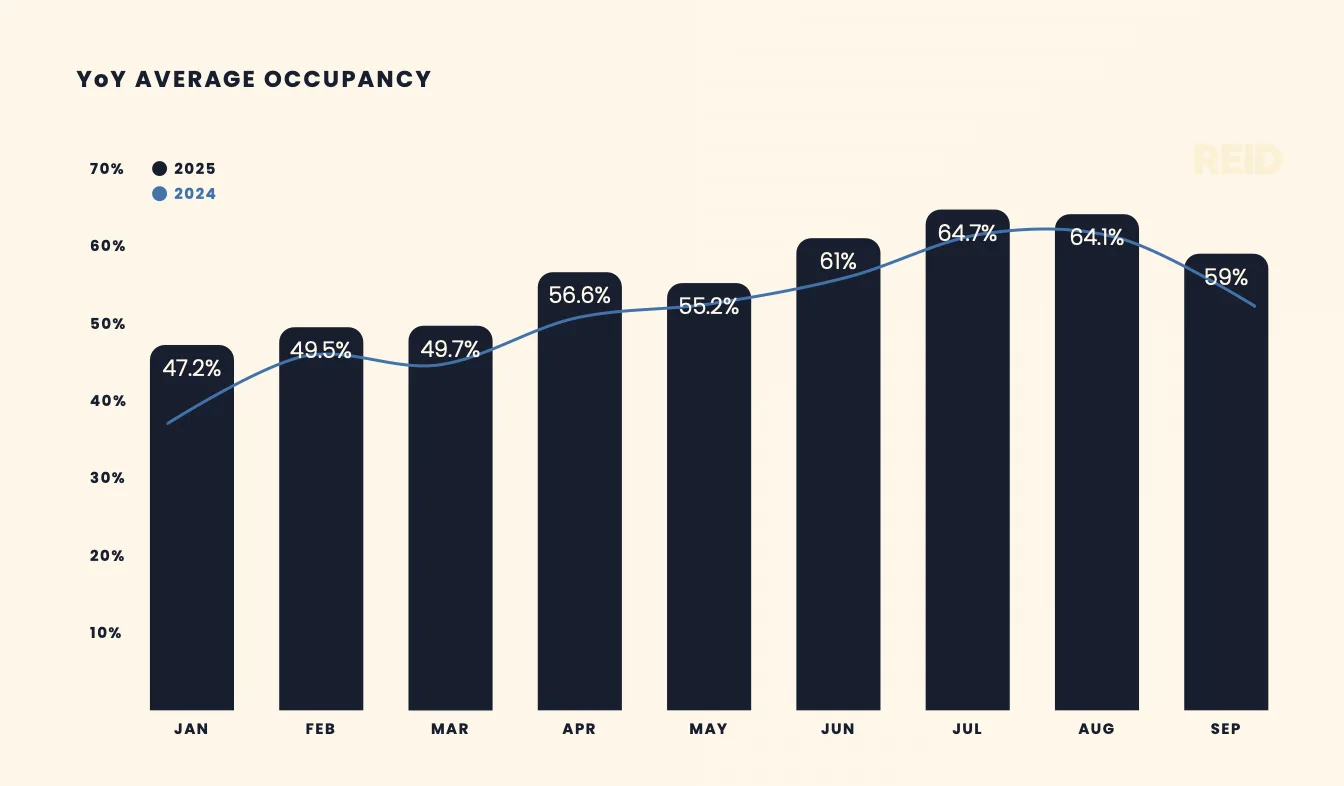
Rental market indicators reveal a similar pattern. REID’s data shows that average occupancy rates continued to rise through 2025, while total rental revenue declined over the same period.
Source: REID, Bali Property Market Report Q3 2025
When viewed together, these metrics suggest that some operators are maintaining occupancy by lowering prices. While this may stabilize short-term cash flow, it alters the quality of income. For buyers relying on rental performance, stable occupancy should not automatically be interpreted as stable returns.
Off-plan activity has also increased, often interpreted as a sign of renewed confidence. However, in the current market phase, the primary risks of off-plan projects lie less in demand uncertainty and more in execution. Developer cash flow structure, construction sequencing, regulatory clarity, and delivery discipline are all being tested more rigorously in a flat market than during expansionary periods.
Supply-side data further contextualizes these dynamics. REID’s Q3 2025 supply distribution highlights continued inventory growth in several regions.
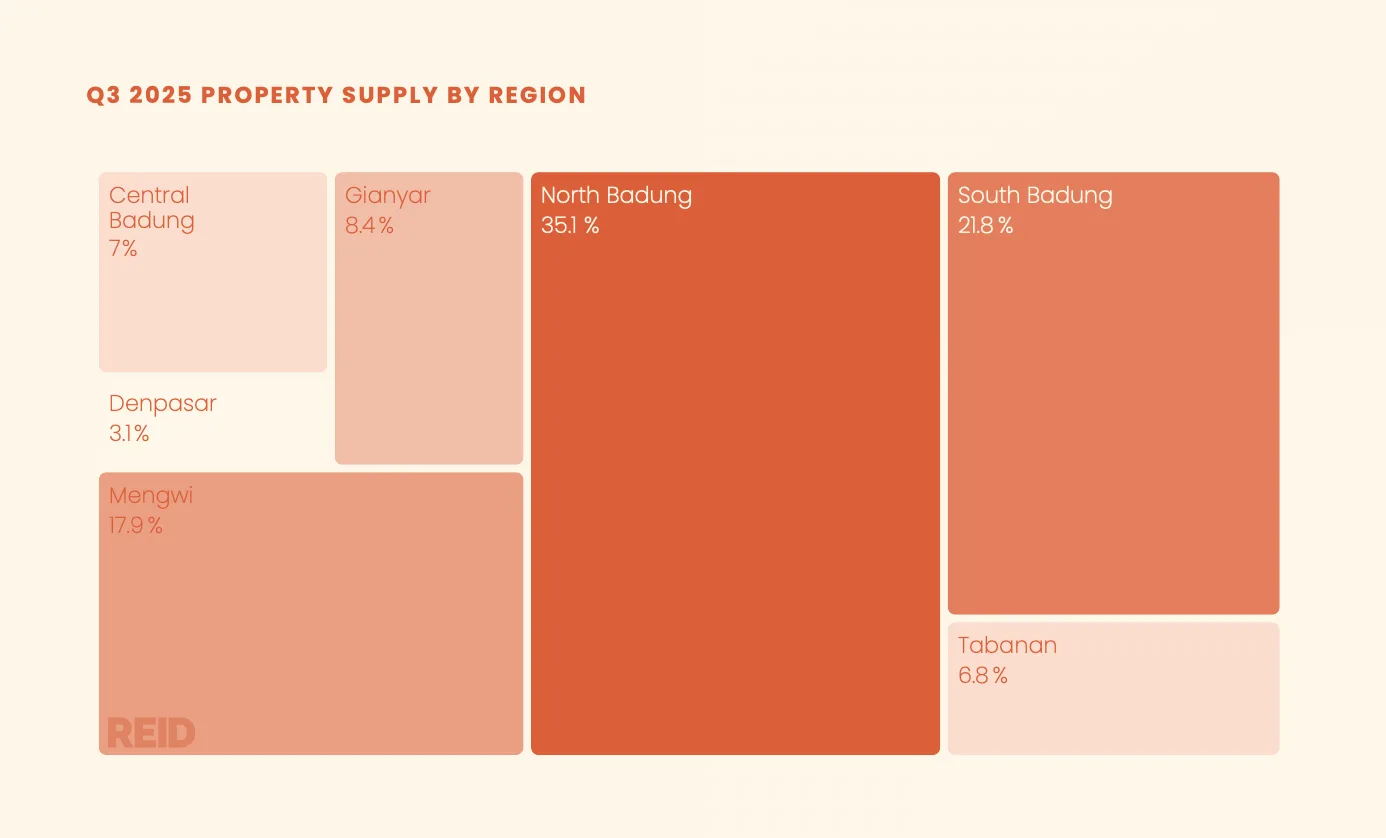
Source: REID, Bali Property Market Report Q3 2025
In such an environment, projects that rely heavily on aggressive yield narratives, premature area positioning, or incomplete documentation face amplified downside risk. Without the cushion of market-wide appreciation, these weaknesses surface more quickly and more visibly.
None of this negates Bali’s long-term fundamentals. The island continues to attract genuine lifestyle demand and an international buyer base. What has changed is the market’s tolerance for error. In 2025, judgment itself has become the primary asset.
For buyers already at a decision point, clarity at this stage often prevents disproportionately larger costs later. The role of analysis today is not to accelerate decisions, but to ensure they are made with full awareness of the trade-offs involved.
If you are already reviewing specific projects, or find yourself uncertain at a particular decision point, you may benefit from a second layer of independent review. In many cases, addressing key questions earlier prevents far more costly corrections later. If you would like to discuss a specific situation or understand how these considerations apply to a real project, feel free to reach out directly at VillaAudit.
This article is intended for market and decision analysis only and does not constitute investment, legal, or purchasing advice.
More insights on markets and investment strategy.
Infrastructure-Led Development and the Future of Yield-Driven Villa Investments
ReadAs gold, stocks, and crypto decline together, global liquidity is tightening. Discover when real estate opportunities emerge — and how to identify undervalued deals in 2026.
ReadA growing shift among global professionals and investors is positioning Bali and Southeast Asia as safe, livable alternatives amid geopolitical uncertainty.
ReadA data-driven analysis of the 2025 Bali property market, covering villa prices, supply trends, rental performance, and what investors should know before buying in Bali.
ReadBuild a strategy framework or compare markets before you commit.